After a discussion with my goddess-in-training sparring partner and housemate about the dream of being parents and the impact children would have on our lifestyles, she sent me a Newsweek article which declares it is a fallacy that having children will make us happier. It's not the first time I've come across this scientific conclusion - many studies have shown that parents tend to measure their happiness and life satisfaction lower than non-parents. But I do wonder about the premise of these studies.
I found an interesting take on it in this article on The Psychologist webpage, which asserts that it has more to do with our focus than our actual level of happiness. Parents tend to spend lots of time worrying about their children and this is what shows up when studies are done. When we think about a rosey future - be it a life-long relationship, being a parent, living in the Bahamas, getting the particular job we really want - we tend to focus on the positive aspects of that future possibility. Of course we don't focus on what's going to be difficult about it or how much work it's going to take. And when reality hits, we focus on the difficult things more than the positive.
It's like when I think about my current work. I have a dream job where I am surrounded by relaxed, supportive, friendly colleagues, with very little power struggle or hierarchical frustrations, where I am paid a decent salary to learn every day, do research and teach. Yet there are plenty of aspects of my work I find a challenge, or frustrating. Right now as I write this blog I am avoiding the preparation that the next subject I am to teach requires, because it is less inspiring than thinking about being a mother and everything that entails! But does that mean I am unhappy at my work? By no means! I can focus on the positive or the negative aspects and the net result will change depending on that. Meanwhile it is a part of a longer career path and overall I am very fulfilled, partly due to the very challenges and opportunitites to learn and grow.
Just as I imagine being a mother will have its ups and downs, and periods of a lot of hard work, yet it is part of something bigger. The biological and emotional call to be a mother has little to do with instant gratification or daily bliss and more to do with fulfilling something human, a call to another phase of adulthood, to a contribution to life and the world around me.
And that is not to say we should all sense and follow a biological or emotional call to be parents. Not everyone wants children. Also, I often have these kinds of conversations with women around me who feel that being a mother will mean sacrificing the full extent of their career. This of course depends on many factors including social infrastructure and flexibility in the workplace, as well as culture (see my post on why there are so few women in higher academic positions). But if it'a question of "what will make me happier - my career or being a mother?" I say the assumption is all wrong that we should be doing things based on a drive for some kind of intangible measure of happiness.
Surely being a parent is not about weighing up the hard work against the moments of reward. I would say the questions being asked in such studies are a bit skewed. Of course no-one enjoys the tasks associated with childcare. But can that be measured against the moments of insight into innocence? Or into how humans grow and develop from crawling, drooling dependent creatures to creative, independent, thinking beings? Or the moments of seeing life continue through you? Or the moments of pride, joy, self reflection, fulfilment? Or the moments as grandparents where it call gets repeated again?
Without the experience (yet) of being a parent perhaps I speak with a bit of a utopian perspective, but at least it's not one based on the disillusion that I will by definition be "happier" as a mother than if I don't have children. It's one inspired by a dream I had of sitting on the grass with my pregnant belly, watching my other young child play in the garden, my man sitting behind me with his legs either side of me and his big chest behind my back. Something essentially human and undeniably fulfilling was coarsing through me. That dream may or may not come true, but it is something that calls me just as much as my career aspirations do and my creative outlets do and the yearning I have to share my life with a partner who is my equal. Will I be happy or happier? I don't know. Will I be fulfilled at a deeper level? I believe so.
(PS - I'd be curious to see comments from anyone who is a parent!)
Wednesday, 25 August 2010


Saturday, 31 July 2010
The New Wonder Woman?

I've posted in the past about Why I Love Wonder Woman and everything she stands for. Her back-story is one of female strength, wisdom and beauty, bestowed by the gods and representing everything that a female warrior is. Her creation is one of early feminism, and she stands for peace and justice. So it's probably about time they made a film about her, among the spate of comic book heroes being brought to life on the big screen.
It's a shame, then, that DC Comics have decided it's time to "update" this 70 year old icon. Modernisation is not a bad thing in and of itself, but if it entails changing everything familiar about this female role model, from her costume to the very roots of her existence, one has to question it. Why, oh why DC???
Their justification for changing her famous costume has been that critics questioned how WW could fight crime without her bits falling out. She's a comic book super hero, people! They always fight crime without their bits falling out! That's why Superman wears his underpants on the outside and Catwoman never has to zip herself in or out of her impossible latex getup.
It should be said, WW has been "updated" in the past. Originally her creator had her wearing a star-spangled skirt, until it was conceded this would be flying up and around her head most of the time she was in action, so they put her in shorts instead. These gradually became hotpants and then even a high-cut leotard over the decades, but at least they remained recogniseable as WW's getup.


Reducing WW's bust size may be a bit of a more realistic move, but removing the gold W from her breast??? Granted, this was only introduced in the 1980's, prior to which WW wore a golden eagle on her chest. She had, after all, been invented during the second world war as an American hero. DC decided to make er appeal more universal by having the Wonder Woman Foundation (an actual women's rights organisation) present her with a doubled W and asking her two wear it to represent women around the world.
So she has seen some changes over the years. The worst was in the 1960's when the story writers for some inexplicable reason decided to remove all her powers and her costume altogether, and name her The New Wonder Woman. She was a mod crime fighter in a fashionable 1960's minidress, but she was not a super hero. Thankfully DC returned to its senses in the 1970's and WW was given back her true identity.
Given that WW's readership has always been slightly smaller than that of her male counterparts, and given the trend of bringing our old fave comic book heros to the big screen, now is indeed the time to vamp up WW's image. There has been talk of a film for many years now, but beyond the basic 80's style animation film that was released straight to dvd in 2009, not much movement has been made. So it is understandable that at a moment of celebrating her 600th (unofficial) issue on paper, DC is looking to gain more attention for its protagonist female, and one suspects the push to film may follow.
But it was a mistake to mess with her backstory, depriving her of the upbringing on Paradise Island (Themniscyra) among the Amazon women, shifting her pacifist origins into an urban commando chic. And it was a big mistake to strip her of the familiar colours and garb we have come to know. Especailly as it has been reduced to bad 1990's bolero fashion and black skin-tight trousers. She has lost all originality.

She resembles the splinter character Donna Troy (right), who was developed from WW's adopted younger sister.
Her bullet-resisting bracelets have become tie-on gauntlets and her corset has an eerily Spiderman-like design.
 And perhaps the black choker was introduced because the new gauntlets have lost their subtle suggestion of S & M (which WW's original creator had as part of her sexuality and her strength). Unfortunately the overal result is a shopping mall teenager instead of a mature arse-kicking ambassador of justice.
DC, if you want to raise the profile of this all-important female hero, do so with some respect for her creation, her symbolism and her long-lasting appeal. If you reduce her to a fashion victim with a less impressive history driving her, the endless stalling of bringing her to film will continue. Everyone wants to put her on the big screen, no-one knows how because of the inconsistencies in her character. Keep it simple, keep it strong. And keep true to what is so insipiring about this feminist, pacifist heroine.
Thursday, 24 June 2010
First female leader for Australia - enter the style police
This morning history was made in Australia as the first female Prime Minster was sworn in by the first female Governor General (the Queen's representative in Australia). Julia Gillard is now the country's leader and the significance of this event is not lost on many women.
 (New Prime Minister Julia Gillard left, Governor General Quentin Bryce right)
The Labour party in Australia voted internally to oust Kevin Rudd, the Prime Minister who was lead Australia into environmental responsibility, and who finally apologised to the Aboriginal population for the way they have been treated as a people. Recently his popularity plummeted and Deputy PM Julia Gillard stepped up to challenge his leadership of the party and of the country. The party gave her full support and she took over the leadership in one night.
Although the support she received from the right faction in the otherwise slightly-left-of-centre Labour party was what made the difference in taking up the lead, Julia Gillard has the courage and unapologetic leadership skills to take this position the way she has. She has said to the media that she made the move because she saw a good government losing its way and she felt it was up to her to keep it on track.
A former lawyer, Gillard worked for an industrial relations law firm, first as a work experience junior, and later as partner. She moved to state politics in 1996, and federal politics in 1998. Australia is a truly sporting nation, and the fact that Gillard is a big fan of Australian Rules football club the Bulldogs raises her popularity amongst the most blokey of Aussie blokes as well.
So why is it that within HOURS of being sworn in as the country's first female PM, this highly qualified, highly educated, strong leader has news items appearing which speak of the colour of her hair (she's a natural redhead) and her style of dress??? With headlins like "Enter the Style Police" and "Julia Gillard needs a new stylist". Why is it that a woman in politics is judged so much more harshly on her appearance than her male counterparts?
A few years ago when Hillary Clinton addressed a graduating class at Yale, an audience of America's most brilliant young women, she remarked with weary irony: "The most important thing I have to say today is that hair matters ... pay attention to your hair. Because everyone else will."
My guess is it's simply because it makes for popular media. Women in politics have had make-overs and been photographed for glossy mags, which can be seen as a degradation of their professional position, but it can also be seen as a way of speaking to women through popular media and demonstrating the many faces of the female role models we have. While it can be frustrating just how much attention was focused on what dress Michelle Obama wore to Barak's inaugrual ball, it can also be seen as a way of drawing popular attention to this strong, influential, intelligent woman in a position of power.

While it's a shame that women have to measure up to the fashion industry's judgment rather than be judged on her capacities professionally, I did learn something from Naomi Wolf's "The Beauty Myth" when I read it as a 16 year old: the popular media culture can be damaging in terms of what we are shown as the "perfect" yet impossible ideal of beauty which we are supposed to compete with and live up to, but it is also a means of mass communication which connects women automatically. In fact it may be an opportunity to display female role models in many different lights.
I deplore the fact that style police enter the scene purely because the new PM is a woman, but I applaud the fact that Julia Gillard is seen as a role model in all forms of media. As long as it continues to be an empowering context, that is!
Wednesday, 9 June 2010
Viva La Burlesque!
I have had many discussions with feminist friends about the pro's and con's of burlesque. One friend doesn't see any difference between this vamped-up, slightly tongue-in-cheek version of strip tease and the pole dancing hype that has recently disguised itself as a form of fitness. To her, it's all about selling female sexuality and fulfilling the ideal of the "male gaze".
Another friend can't see any similarities between these two worlds. Stripping and pole dancing are cheap, false versions of sexuality to her, and burlesque is all about the celebration of the body in all its glorious forms, the women owning the stage and using narrative to express themselves positively.
I guess I'm somewhere in between. There is something beautiful about a pole dancer who really brings dance and skill to her art. (Check out Ali Robbins) The discipline and strength needed to make it look graceful is impressive. That said, there is plenty about the strip joint and the typical pole dancer that is abhorrent to any woman who claims her sexuality as her own, since it is a commodification of sex and sexuality at its cheapest and with one impossible physical ideal at its centre.
Burlesque, on the other hand, is all about the celebration of sexuality and the diversity of female bodies, and each and every performer has her own style, her own touch, her own wink. She determines what she wears, what she dances to, for how long she is on stage, what she takes off and how, and there is such a playful edge to it all. One of the most famous burlesque dancers in Amsterdam has enormous breasts, a big nose and large lips which she paints bright red and covers in glitter. And she is fabulous and sexy as she twirls her tassled nipple-covering pasties and waves her big feather fans or tap dances across the stage.
Burlesque originates in the 19th century cabaret and circus world, where dances were becoming raunchy and acts mixed music, dance and more than brief glimpses at the female form. At the turn of the 20th century, Isadora Duncan danced barefoot and used Grecian imagary as she stipped off thin veils of cloth, everything about her movement sensual and beautiful and artful, nothing reminiscent of can-can dancers.
 And in the 1920's Josephine Baker danced topless as the roaring 20's let women's freedom on the dancefloor speak of a certain sexual freedom as well.

In the last decade or so burlesque has seen a revival in many cities around the (western) world, and classical burlesque performers range from Dita von Teese, who does large-scale performances in a giant chamapgne glass, to Pepperminsky who immitates the Sally Rand feather dances, to those who bring the circus element back in and make it all a bit of a laughing matter. And then there is the neo-burlesque, the boy-lesque, and the combination of various arts (ballet, modern dance, charicature costumes, club music and dance tracks, narrative burlesque, fire-breathing and fire juggling, swords, belly-dancing, gothic, fetish, you name it!).


Another friend can't see any similarities between these two worlds. Stripping and pole dancing are cheap, false versions of sexuality to her, and burlesque is all about the celebration of the body in all its glorious forms, the women owning the stage and using narrative to express themselves positively.
I guess I'm somewhere in between. There is something beautiful about a pole dancer who really brings dance and skill to her art. (Check out Ali Robbins) The discipline and strength needed to make it look graceful is impressive. That said, there is plenty about the strip joint and the typical pole dancer that is abhorrent to any woman who claims her sexuality as her own, since it is a commodification of sex and sexuality at its cheapest and with one impossible physical ideal at its centre.
Burlesque, on the other hand, is all about the celebration of sexuality and the diversity of female bodies, and each and every performer has her own style, her own touch, her own wink. She determines what she wears, what she dances to, for how long she is on stage, what she takes off and how, and there is such a playful edge to it all. One of the most famous burlesque dancers in Amsterdam has enormous breasts, a big nose and large lips which she paints bright red and covers in glitter. And she is fabulous and sexy as she twirls her tassled nipple-covering pasties and waves her big feather fans or tap dances across the stage.
Burlesque originates in the 19th century cabaret and circus world, where dances were becoming raunchy and acts mixed music, dance and more than brief glimpses at the female form.
 At the turn of the 20th century, Isadora Duncan danced barefoot and used Grecian imagary as she stipped off thin veils of cloth, everything about her movement sensual and beautiful and artful, nothing reminiscent of can-can dancers.
 And in the 1920's Josephine Baker danced topless as the roaring 20's let women's freedom on the dancefloor speak of a certain sexual freedom as well.
The Hollywood choreography, the large feather fans and the sneak-peek at the female form became the taste of the 1930's. In the 1950's the glam pin-up style burlesque was a trend unto itself, and while Betty Page took it to another level, there was always a wink, a slight innocence, as if the disappearing layers of clothing were almost accidental.
In the last decade or so burlesque has seen a revival in many cities around the (western) world, and classical burlesque performers range from Dita von Teese, who does large-scale performances in a giant chamapgne glass, to Pepperminsky who immitates the Sally Rand feather dances, to those who bring the circus element back in and make it all a bit of a laughing matter. And then there is the neo-burlesque, the boy-lesque, and the combination of various arts (ballet, modern dance, charicature costumes, club music and dance tracks, narrative burlesque, fire-breathing and fire juggling, swords, belly-dancing, gothic, fetish, you name it!).


The reason I love the scene is that it is diverse, celebratory, free and all about the performers celebrating their bodies as they are - reagrdless of age, colour, size, shape. And the audiences are often made up of at least 60-70% women, who more often than not dress up in corsets, fascinators, frilly knickers or skirts, over-the-top high heels and long gloves. It's the opportunity to get playful, permission to think of oneself as a sensuous goddess and enjoy one's body and that of others in a non-judgmental, playful atmosphere.

And though it has nothing to do with the male gaze, the funny thing is the men enjoy it at least as much as the women. There is nothing sexier than someone who finds themself sexy exactly as they are and wants to celebrate that!
And though it has nothing to do with the male gaze, the funny thing is the men enjoy it at least as much as the women. There is nothing sexier than someone who finds themself sexy exactly as they are and wants to celebrate that!
(In Amsterdam check out http://www.madamerisquee.com/index.html)
Monday, 7 June 2010
Women in Power

Last month I attended a 4 day workshop in the north of England with women from all over the world, under the guidance of ALissa Starkweather and some other highly trained women. We were taken into a ritualised world of symbolic animalism, of shadow work, of reconnecting to our inner predators and in doing so, reclaiming our power.
The weekend is called Women in Power and I would recommend it to absolutely any woman interested in doing some deeper work on herself. (it's only held once a year in the UK and not yet anywhere else in Europe, but a few times a year in the US, so check it out!) Some women went to heal old wounds, to claim a power they hadn't yet dared to claim as their own, to find their voice. I went because I know I am a powerful woman, but I have never truly owned all of my power, particularly that of my predator energy!
Jung spoke about our shadow as being the disowned part of ourselves, which we either try to supress or project onto others, never taking responsibility for it and therefore rather than owning it, it owns us. For me, the shadow is an anger, a hatred, a buried aggression, a desire to destroy. I saw so much anger and aggression around me as I grew up that I swore I would never be the way my angry, bitter parents were towards each other. But in doing so I disowned that aggression and it comes out left, right and centre without my willing it to.
Through the work we did over this magical weekend, I got to really enact and own that shadow in a safe space, where the women around me trusted my shadow. I got to feel what it is to destroy, and to recognise that this shadow is jsut energy, like everything else, wanting to be expressed. I discovered it is life energy and it wants me to know I am life itself. And through this I came to the recognistion that I am both destroyer and life-giver, like the dark goddess Kali.
I had women who are mothers bless my womb, I got to ritualise the abortion I had over 10 years ago and finally let go of the dead energy I had secretly been carrying around. I got to see other women look their own shadows in the face and be with their darker sides like never before. And I discovered my purpose in this: to hear and take the suffering of others, swallow it, devour it, abort it and bury it. Destroy the suffering that life may be given anew.
We shed so many tears as we felt compassion for each other, we laughed out loud, we discovered fun things about women's sexuality and biology, we ate divine food together, we danced and sang together, it was a transformational weekend. We all left feeling powerful, beautiful creatures.
Not everyone is open to taking on this kind of thing, but it's such important self-actualisation, self-awareness, growth and individuation. I was turned on to it by a friend who has done similar work with the Mankind Project - I was so excited to learn men are doing this kind of work together! There is nothing sexier than a man who knows himself and who is unafraid to step into his masculinity. And now to step into the predator, destroyer part of myself, I trust and know myself on a deeper level than ever before, and I can step into my femininity, knowing it has many sides to it and I own all of them.
I always thought of myself as a powerful woman. I now know myself to be a woman in my power.
Thursday, 29 April 2010
Why I love Wonder Woman

Anyone who knows me knows of my almost obsessive fascination with the pop culture icon Wonder Woman. She is less well known in a lot of European countries, but in the Anglo-American world she is on equal par with Catwoman, Supergirl, Superman and Batman. In fact she is a member of the Justice League and stands together with Batman and Superman as one of the lead characters.
But why this fascination? For the very fact that she is one of the few female heroes who actually offers something inspiring beyond skin-tight, revealing super outfits and impossible proportions. And for everything she stands for.
Wonder Woman was created by the psychologist William Moulton Marston in the 1940's. he had written a series of articles on the importance of (super) heroes as role models and the role of pop culture in this positive modelling. DC Comics approached him to create a character and he rightly pointed out they had NO female heroes. So he dreamed up Wonder Woman, an Amazon Princess whose job it was to teach humanity, then in the throes of World War II, about justice, peace and truth.

The back-story of this character is full of symbolism and heavily influenced by Greek mythology. On the island of Themniscyra, hidden in the Bermuda Triangle, a community of Amazon warrior women lives in a paradise of peace and immortality. Their task is to guard over Pandora's Box, and if any man's blood is shed on their island then the Box will release all manner of darkness into the world. (Read: Women as protectors, the mother energy, guarding the dark side of humanity.)
The Queen, Hyppolita, misses only one thing - a daughter. Living in a paradise of only women has it's downfalls, there is no male company to balance things out. Instead she prays to the gods and moulds a child out of the clay of the earth, and the gods bestow life upon this girl who is literally of the earth. (Read: Women as mothers, as creators, the earth as the ultimate life-giver, intutitive connection to the gods.)
They then bestow gifts of beauty, strength and wisdom upon her - so no weird chemical reactions or spider bites, but heavenly powers giving her a goddess-like status. When she comes of age she wins a contest to donne the crown of Wonder Woman and go off to "man's world" to teach the justice and peace oriented ways of the Amazons. (Read: Self sacrifice and leadership, seeking balance in conflict, offering feminine wisdom to the masculine fighting spirit.) She embodies what is often seen as an essentially feminine purpose - the healing of the world.
She carries a lasso of truth, which forces those whom she ensares to tell the truth, the whole truth and nothing but the truth. Masterton is credited with having also invented the lie detector, so his fascination with truth-telling came through in his comic book character. Not only that, but his poly-amourous relationships and his study (and his practice!) of bondage and BDSM, and the dynamics of power and gender in this form of sexual expression, are reflected in WW's costume (the slave bracelets, the lasso) and the regularity with which she is tied up, bound, locked down and has to escape.
Despite the fact she was a product of the World War II years, she is shown breaking these bonds and chains with the regularity and deftness of a modern feminist (no-one is ever to blame, she simply busts out of the shackles and continues her message of equality and peace). She embodies the wisdom and strength of a mature elder, the independence of a woman who knows she doesn't need to play any certain role in life to be fulfilled, and yet the perfect complexity and emotional paradox that many women express - searching for what fulfills her heart she is unafraid to cry and show her vulnerable side in between fighting the Nazi axis or her more fantastic nemeses. She has the female warrior power as well as the softer, flowing feminity, a wholeness so many of us desire.


Thankfully, with some strange twists in continuity, she was given her powers again in the 1970's (perhaps again due to shifts in sexual politics?), and the camp TV series with Lynda Carter gave her a new place in pop culture.
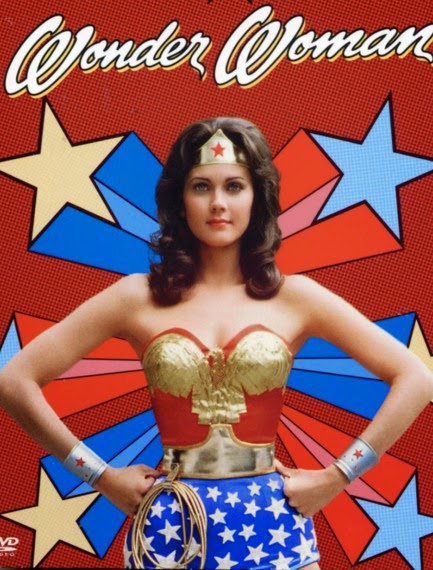
Whether the TV series was true to her deeper symbolic side remains highly questionable, but the fact that she was sky-rocketed to the forefront of the imagination of boys, girls, men and women alike says something about how right Masterton was all along that we need heroes and positive role models.
And preferably something more than the latex-clad Catwoman who emodies the seductive, "dangerous" myth of women's sexuality, and something beyond the submissive, diminiutive role played by Supergirl.


We need a complex, multi-faceted, mature woman, a Wonder Woman to inspire us. Her strengths and weaknesses, her beauty as well as her wisdom, her mothering nature as well as her her warrior energy, and her kick-arse sexuality, these are all the reasons I love Wonder Woman and proudly wear her symbol on my wrist!

Any woman with any inkling of these characteristics in herself is a Wonder Woman.
Wednesday, 21 April 2010
Entering the playing field
A friend of mine, Nico, whose 50th birthday was celebrated last week in the theme "Lust for Life", wrote the following in response to reading this blog. It's an honour to be able to share his thoughts here:
"I find myself struggling with new feeling inside myself. I guess it is spring and new feeling want to grow, blossom and bloom. Or maybe it is because I have entered the age of the big five-o. When I discussed it with friends the thought rose that it could be my male side developing further. Being a 50 year old man this thought was both promising and disturbing. There was a good point in it, but not the point to win the game
Then I realized myself that it is probably a next step in the path that started a few years ago. I discovered that my possibilities in life are Love, Power and Joy. Since then I have been growing into the person I am now. Love, power and joy are now firm foundations in my personal life and in my personal relationships with my kids and my friends. The thing that seems to be growing is the next step of bringing these possibilities into the world on a larger scale. So out of my personal world into the open world.
I realize myself that this may be another term for developing the male side. Personal environment and especially the care for children is normally considered the female side. And using power to change the world on a larger scale is seen as being the male side.
As I am entering this new playing field I realize myself that I need a new tool set to be successful. In my personal life it is the ability to handle feelings (understand, interact, show) which is the key to success. Out in the open world this is not the case. It is the ability to handle action that is needed: come into action, bring people into action, inspire, steer, energize, make/keep the motor running.
There is both a promising and a disturbing side to this insight. The promising side is that I will find ways to bring love, power and joy to the world, and that this will make the world a better place to be in. The disturbing side is that I have to leave my warm and safe personal world and step out in the open. I do not have to lose this warm and safe place completely, but at least partly as you cannot do everything.
As Spiderman said: “With great powers come great responsibilities”.
And then I realized. Maybe it is not the male/female thing. Maybe it is just growing (up?). Entering a new playing field, with new rules, and new types of relationships with others who share the same goals: making the world turn into the right direction. Let’s play!"
Subscribe to:
Posts (Atom)


