It's a while since I wrote about my excitement that Tim Burton had given us a true female heroine in his Alice in Wonderland film in 2010 (see my old post). Finally a popular story presented to a mainstream audience with the central female heroine displaying all sorts of the traits and struggling through the questions that the path of the feminine heroine takes.
Myths and fairytales are often used to demonstrate the archetypes of individuation and the struggles we face on our path of growth to wholeness. Facing our shadows, our demons, separating from our parent and family paradigms, finding our "true" selves.
The confusing thing for a woman seeking to find symbolic clues in many of these stories is that the majority of them focus on the hero's journey. The masculine path. And the heroine's journey is a different one. Women must face demons and shadows, but our trials and tribulations are different, when focusing on the feminine, than those for men, focusing on the masculine.
I can draw much inspiration and meaning from a story about the hero's journey because I too must seek to know my masculine self, my animus. But I must also seek to know my anima, my feminine self, and my path of individuation will therefore be different from my male friends'. While we all seek to find balance, the focus will be different.
I therefore celebrate bringing more symbolic stories of the feminine journey to the mainstream. And the producer of "Alice in Wonderland" have thrown it up a notch to bring us "Snow White and the Huntsman".
A quick look at the synopsis shows that the huntsman who is sent by the vain Queen (who declares beauty to be her power) to kill Snow White, ends up training her to be a warrior to kill the Queen. Take note: it is her own acceptance of the masculine warrior archetype that allows her to be trained and find it within herself. This is not the man who comes to save the damsel, it is the masculine who helps transform the naive young feminine on her heroine's path to wholeness, to individuation, to her full self. It is balance between masculine and feminine and there are all sorts of other archetypes in the story to follow the Jungian analysis.
I look forward to seeing this film with the same kind of goose-bump anticipation that I have when there is a reason to scream out loud either in joy or anger. Either way there is some exciting release about to come!
Friday, 23 March 2012
Saturday, 15 October 2011
The Neo-Cons hijacked Wonder Woman!
I have to admit, I am a little concerned. It's not just a matter of resisting the re-writing of a character who I consider to be pop culture's most important female role model. It's not just a matter of resisting change as such. Heck, when they showed photos of model-come-actress Adrianne Palicki in the newly styled Wonder Woman latex costume I kinda thought it was hot. 
At least it was an improvement on the attempts to re-vamp the comic book character's outift a couple of years ago, when she looked like a 1990's fashion victim (see left)....
Wait a minute. I'm sorry WHAT???? Does this not sound reminiscent of the Bush


No, my concern goes deeper. Having just watched the 2011 pilot of the NBC Wonder Woman series, I am convinced that some neo-con lawyers were heavily involved in the script-writing. I know it sounds funny, but I am serious - there is some uncomfortable political agenda behind much of the script. And the consistent "evil-eye" hard face worn by Palicki throughout the pilot episode did nothing to soften the blow of references to torture as evidence gathering, manipulating the legal advisory department to sidestep the law, and use of the PATRIOT Act to justify some highly questionable behaviour.
Wonder Woman's character was invented by a psychologist during the second world war when DC Comics approached him to create a new patriotic hero. He was an adamant feminist and created the first female superhero, whose powers were bestowed upon her by the (Greek) gods and goddesses. Her task was to bring the lessons of peace, love and justice to a world that was warring. She was given a lasso of truth and bracelets to deflect bullets. Wonder Woman never attacked, she only ever defended....
70 years later, in the umpteenth attempt to bring Wonder Woman back into mainstream popularity, Palicki lashes out with her golden lasso and strangles people to unconsciousness, she threatens wounded bad guys and jabs them with needles to get blood samples. In fact she silently admits to using torture to elicit evidence from one man. Her detective ally refuses to let her make a move based on this evidence gained as "poisonous fruit" but she remains righteous - apparently if many lives are at risk, it's ok to torture the bad guy.
Wait a minute. I'm sorry WHAT???? Does this not sound reminiscent of the Bush
administration's justification of the use of torture to elicit evidence from detainees in Guantanamo Bay and hundreds of other locations around the world where the CIA sent their "extraordinary renditions"?
Any international lawyer will tell you that the prohibition of torture is one of the few absolute pre-emptory norms which exist in concrete terms. Despite what the neo-con lawyers were advising the Bush administration in the torture memos.
It went further in this disturbing pilot episode. At one point, a character who is Chairman of the Senate Judiciary Committee confronts Wonder Woman, accusing her of such disgusting behaviour that "not even the most liberal reading of the PATRIOT Act would justify what you did". The USA PATRIOT Act - in full, the "Provide Appropriate Tools Required to Intercept and Obstruct Terrorism" Act, introduced in 2001 - was a bill passed in response to the Sept 11 attacks. It removed numerous procedural restrictions on police, FBI and CIA actions, leading to indeterminate detentions, huge invasions of privacy, a veritable roll-back of civil rights in the US and a discriminatory focus on immigrants. It was also was part of the neo-conservative lawyers' justification for the use of torture.
So what is one to think of the fact that the woman whose original task was to teach the ways of truth, peace, justice and sexual equality, has now been reinvented as a unilateral crime-fighting

machine who goes above and beyond the law, ever scowling at both her enemies and her allies, threatening and in fact using force, justifying torture to elicit evidence?
Her "don't mess with me, I'm a hard bitch" face seemed to portray this deep shift in political paradigm. (I'm serious, she only smiled once in the whole episode, when she spoke to the victim around whose plight the episode centred, and of whom she made a point of informing everyone at her press conference that he was a black teenager from the ghetto. I was a bit confused until her new right wing stance started to become evident, and my only conclusion was that this was an attempt to show she really does care about the underdog. Kind of like Bush flying over New Orleans a few days after Hurricane Katrina, to show he really cared, too.)
Perhaps this 21st Century Wonder Woman is after all completely in line with what happened to the national identity of the country for whom she was invented 70 years ago. Then it really was about bringing ideals as a leader to a new world order. In recent decades it has rather appeared to be about imposing ideals as a unilateral world police force down the barrel of a weapon of mass destruction. Perhaps I shouldn't be so disturbed that my long-time heroine is once again speaking the truth, I should just accept that the truth is a little uglier. Perhaps I should accept her ever angry face as the replacement of the one that was created of the earth and bestowed with Aphrodite's beauty and Athena's wisdom, just as the face of US foreign policy has lost its beauty in the decades since the second world war.
Still I am disturbed, and it's because of the very reason I love (the original) Wonder Woman so much (see my previous blog posts). She is a pop culture role model. If she is now the voice of the 21st Century America, it disturbs me that this might be internalised by the next generation of world leaders.
And I am disturbed as to what happened to her feminist ideals as well. She used to be a champion of sexual equality, (apart from demonstrating that women can be both strong and vulnerable, in one comic book adventure rather than act from pure hatred or righteousness, she

convinced a female member of the Nazi regime to return to her humanity and abandon the Nazi project) now she is spitting hatred at the sight of another powerful, beautiful woman and threatening to kill the female villain played by Elizabeth Hurley (shown left in character).
And although Palicki's Wonder Woman makes a point about dolls being made in her likeness with impossible breasts, she admits that she needs to sell them in order to fund her crime-fighting, and she even uses her latex-packaged breasts to sexually intimidate men: "Like my outfit officer? This outfit opens doors for me. It's gonna open that one, isn't it?!"
I'm not sure this was what Wonder Woman's original creator had in mind when he published in The American Scholar in 1941:
"Not even girls want to be girls so long as our feminine archetype lacks force, strength, and power. Not wanting to be girls, they don't want to be tender, submissive, peace-loving as good women are. Women's strong qualities have become despised because of their weakness. The obvious remedy is to create a feminine character with all the strength of Superman plus all the allure of a good and beautiful woman."
I breathed a sigh of relief to read that NBC has already axed this failed pilot. And I have to re-iterate, it's not because I'm opposed to an update of Wonder Woman. It's because her core values had been hijacked for disturbing political ends. It's not the fate we should wish upon any super hero!
Thursday, 8 September 2011
Rebalancing the voice (letter to a friend)
Please forgive the way in which I communicate what it is I am committed to. Fact is I remain committed to distinguishing and discovering and restoring equality. It is my drive as an international lawyer, it is my purpose in life. It is part of who I am as a woman. And it is not only about equality between women and men, it is about equality between all human beings. And equality of the resources we have to live with.
So when it comes from a breath fuelled with fire, I apologise if it leaves you feeling scorched, and if it leaves the echo of a racket rather than of speaking to a possibility. The world I speak about is not cold, it is quite the opposite. But the way I speak about it is still driven by the rage I have at injustice.
And it is driven by the fact that certain voices have been silenced over time, and when these voices get loud they are told to calm down, be nice, wait their turn. But it's only because these voices dare to get loud that social change is made possible.
What interests me is how the pendulum swings. How to access the unsaid. And how to find the middle point of rest, the point of balance and equality, between the swinging extremes. In that I acknowledge that my rage-fuelled voice is too loud, and is still informed by the past.
When I said I am searching out the rebalancing, what I mean is I am still learning and discovering how to communicate it without there being the accusations I used to speak with, and without it being about fixing a wrong, but rather about inspiring towards something where we are all fulfilled.
And when I said I am searching out the rebalancing, what I also mean is rebalancing gender, but it's also about consciousness and unconsciousness, about shadow and divinity, about the mascuilinity and femininity in all of us, the animus and the anima.
It's my "new model", I'm just still figuring out how it all fits together and, more importantly, how to bring the dialogue about it when there is indeed a lot of righteous rage caught up in it.
Please have patience with me as I figure this out. This is truly important to me and to the world I wish to live in.
Please read this blog - it's part of this process of learning to articulate what comes up for me in those moments.
Much love and respect
xx
Saturday, 16 July 2011
Love letter to my man
If the King is the rock, the core of the earth,
then the Queen is the soil, the plains, the fertile land.
His leadership, lordship and blessings over the soil
will have her flourish and fulfilled.
Like the Pharoah whose seed kept the Nile rich
and fertilised;
Like King Arthur whose even, just leadership
kept the people ordered, calm and happy;
the Queen who is granted the space
and the just leadership and blessings
to grow and flourish and be her full self,
will provide the fertile land for her King
to fulfil any of his grand plans and wishes.
She will offer her lands to him
from which he too can grow and build and be his full self.
And she may test him
with her unpredicatble, tempestuous nature,
and her ocean of emotions,
and her questions and taunts.
But in the end all she is seeking
is reassurance
that her King will remain rock solid
in the face of her changeable nature
So that she may relax
and give in, and give herself entirely
to him.
And together,
rock core, fertile soil, and the nourishing water of their love,
Earth, Air, Fire and Water,
They create and fulfil Life itself.
then the Queen is the soil, the plains, the fertile land.
His leadership, lordship and blessings over the soil
will have her flourish and fulfilled.
Like the Pharoah whose seed kept the Nile rich
and fertilised;
Like King Arthur whose even, just leadership
kept the people ordered, calm and happy;
the Queen who is granted the space
and the just leadership and blessings
to grow and flourish and be her full self,
will provide the fertile land for her King
to fulfil any of his grand plans and wishes.
She will offer her lands to him
from which he too can grow and build and be his full self.
And she may test him
with her unpredicatble, tempestuous nature,
and her ocean of emotions,
and her questions and taunts.
But in the end all she is seeking
is reassurance
that her King will remain rock solid
in the face of her changeable nature
So that she may relax
and give in, and give herself entirely
to him.
And together,
rock core, fertile soil, and the nourishing water of their love,
Earth, Air, Fire and Water,
They create and fulfil Life itself.
As You Like It
A gorgeous summer evening, lying on a blanket with a picnic dinner under the dappled light of trees in the arboretum of Cornell University, upstate New York, I watched a great production of Shakespeare's "As You Like It" tonight - and for the first time the gender twisting antics of his comedy struck me as utterly post-modern!It was a traditional period production, put on by the Ithaca Shakespeare Company on a lovely in-the-round stage outside and surrounded by woods. The choice of costume was what one expects of a small budget but serious
Shakespearean theatre company, with layers of lacy skirts and corsets for the women and knee-high socks, knickerbockers and waistcoats for the men. In many of Shakespeare's comedies, mistaken identity and women disguising themselves to their lovers by cross-dressing tickles audiences as much today as in the 17th century. Which is why the period costume lends itself to turning gender assumptions upside down.
The men wore high heels, wigs with long curls and pony tails, lacy cuffs and collars, tights and puffy pants or knickerbockers. Extremely effeminate.

And when the leading woman, Rosalind, disguises herself as a man, she looks more masculine than the men do, with her own hair tied back and her legs firmly placed on the ground.
Meanwhile there are many quips about how Rosalind and her cousin Celia share a love "dearer than the natural bond of sisters", intimating a lesbian bond between them. And at one stage a peasant girl falls for Rosalind, incognito under the name Ganymede, despite Rosalind's protests that she loves "no woman". Yet all the while Rosalind, in her male alter ego, befriends Orlando who is in love with Rosalind but doesn't know he is speaking to her, and makes him pretend she IS Rosalind in order to test his love for her. So while Orlando believes he is playing out feigned love scenes with another man, there are homo-erotic and cross-gender, pansexual undertones.
She has her male suitor woo her while she is disguised as a man pretending to be a woman. Confused yet? Good. This is what started to strike me throughout the performance as Shakespeare's ultra modern gender bending politic.

Jokes are made about the so-called "weaker sex", yet the women carry the entire narrative and are the stronger characters by far. And the peasant girl who falls for Rosalind/ Ganymede is a dominant, rough and rude woman, who is pursued by a truly submissive man for whom she has no respect - but who loves her all the more for it.
In the end all is restored to "normalcy" as Rosalind emerges in feminine flowing finery to marry Orlando, the peasant girl realises her amour was directed at a woman who would never have her and instead accepts the hand of the submissive man, and there are 8 heterosexual marriages to conclude the play just in case we should have been led down the path of believing this cross dressing and gender bending was anything but comical...
But this is not the only play of Shakespeare's in which these cross dressing antics appear (Much Ado About Nothing), or in which he played outright with stereotypes of "the weaker sex" (the daughters in King Lear), the changeable feminine emotional nature (The Taming of the Shrew), the corruption of man by the shadow side of the feminine (Macbeth), the shadow side of the masculine (Richard III, The Merchant of Venice) the relationship between the feminine and nature or magic (A Midsummer Night's Dream, the witches in MacBeth), the expectations of the masculine leader (Hamlet).
Considering he wrote at a time when women were not allowed to appear on stage, Shakespeare wrote a lot of very strong female roles, and challenged gender stereotypes both contemporary

and timeless. The fact that boys would have played these roles makes the cross-dressing and gender-bending aspect even more of a visual and cognitive challenge and delight! This is one of the reasons Tom Stoppard's film "Shakespeare in Love" was such a clever re-telling of Shakespeare's stories. The women, including Queen Elizabeth played to perfection by Judi Dench, are all strong characters standing where the audience and characters expect men to stand and challenging not only gender stereotypes but perhaps also heterosexist assumptions. There are male-to-male love scenes and Gwenyth Paltrow looked particularly sexy dressed in finery
but still sporting her fake moustache and goatee beard.
The more I think about it, the more I am convinced the bard was a postmodernist, anti-essentialist writer a few centuries before his time!
Tuesday, 19 April 2011
Ah! My Goddess!
I have become addicted to a most curious Japanese anime series called "Ah! My Goddess!" It's so odd and at the same time incredible! A young man, Keiichi, is struggling through life, always suffering misfortune, everything seems to go wrong for him. But despite this he is still generous to others, which catches the attention of the goddesses watching down over earth (and all the other stars and planets which make up the system of birth and death).
One evening he makes a phone call to a friend but instead is put through by unknown forces to the Goddess Helpline (of course there is a Goddess Helpline, didn't you know?!) and a goddess appears to grant him a wish. When he tries to think of what to wish for he can't think of anything he feels
worthy of. The goddess, Belldandy, starts telling him how he is surrounded by love because of how he makes other things and people feel worthy and loved and that he is truly a good person who other aspire to be like. He is so blown away by her and by her words that he wishes to have a goddess like her by his side forever...and so begin their adventures.
When the wish takes effect, (and is registered in the Goddess system!) Belldandy must literally stay by his side. Forever. If they try to separate in any way then the "system force" comes into play and something happens to ensure they are not separated. I mean obviously, when something is registered in the Goddess System it cannot be undone, right? Be careful what you wish for!!
All sorts of archetypes keep showing up, like the queen and the lover, and Belldandy has a guardian angel - who she introduces as her higher self - who guides and protects her. She uses her powers now and then and prays to the spirit of money or sustenance to take care of their needs, and they are always instantly taken care of - although it doesn't necessarily appear that way at first. Sometimes things don't look the way Keiichi wants or expects, and he complains about the hardships, but she keeps chirping that as long as they are together she is happy, and that they are so blessed by everything, and at the end of each episode he realises that things in fact have worked out for the best.
He starts to realise that if you follow the goddess' lead you will find yourself in a place that soothes your soul (his exact words!). There is so much I love about how this is an anime translation of the concept of manifestation, trusting your higher self to lead the way, and asking the universe to take care of your deepest desires and needs. Things don't always show up the way we expect them to, we don't always like what we see, but we are always being provided with what we need. Instead of letting the mind think it's in control, let the spirit guide the way. If we just trust there is a higher force - the "Goddess system force" to be exact! - and don't try to resist it, then everything will be taken care of and provided for.
This notion of manifestation is exactly what "Ah! My Goddess!" is all about! The opening episode begins with a narration by the goddesses questioning how much of our lives is fate and how much is up to our choice to be open to possibilities. The universe is always listening, your thoughts and attitudes will always be answered. If you think "I wish I had more money" then the background thought is "because I don't have enough". The universe will respond to this thought of origin. You will experience more wishing, more longing, more of "because I don't have enough". This manifestation of misfortune for Keiichi was a result of his continued monologue about how misfortunate and unworthy he was.
But if you think "I am grateful for the abundance of money and wealth (love, great friends, health, whatever) in my life and for its continued increase" then you will experience gratitude and wealth (and love, great friends, health) and the universe will bend to your will and provide more opportunities for gratitude and more wealth (love, great friends, health, etc).
This is what the goddess Belldandy slowly teaches Keiichi in each episode. Be grateful, ask for what you truly desire, and let the system force click into place. Single mindedness (in the sense of having a clear, directed vision of where you want to be in the near and distant future, not mixing it with doubt or and unclear heart) is the key. And be aware that you will get exactly what you wish for - a goddess by your side FOREVER? Then that's exactly where she will be. Forever!
It's a cheesy script and an incredible concept. Really worth a giggle: watch a couple of episodes here!
Tuesday, 12 April 2011
Valkyries of War
Though I would not be proud to stand up and say that women are equally responsible for atrocities committed in times of conflict as men, it would be a false dichotomy to deny it. In fact, I find the tendency to point the finger at men for being the wagers of war, and to assert that if more women were in power we'd have less war, to be utterly abhorrent.
Why? Because it creates a divide, and perpetuates another war that is otherwise slowly dying out and really has had its time. The battle of the sexes is no longer a war we need to fight. To lay the blame at the feet of one gender and expect that women, purely by reason of their gender, would not resort to war in international relations, is a naive and divisive standpoint.
This idea has been challenged recently with some interesting twists in the media. Obama was at first reticent to use force in Libya, and many of his (male) security advisors were against getting involved in another expensive, uncertain conflict on foreign shores, given the messes in Afghanistan and Iraq. In the end it appears it was due to the pursuasiveness of three top women advisors in his administration that he was convinced to take military action. And because it was three women, the media leapt on it.
They have been called the "Valkyries of War", and the mission has been dubbed by one journalist as the "war of the three sisters". Juicy stuff! And cause for many questions.
Secretary of State Hillary Clinton, together with Samantha Power, senior policy advisor on the National Security Council, and US ambassador to the UN Susan Rice, are "credited" with having made the final push on the no-fly zone and the US involvement in the UN authorised use of force in Libya. And of course the media love this unlikely trio of war-hungry women, with New York Times stories of the "girls taking on the guys" in the White House, and NBC stories covering the phenomenon of women policy advisors taking on the men.
There seems to be a suprise that women would give the push for involvement in warfare. But there are two sides to this story to consider.
One is that women have, unfortunately, but realistically, been involved in warfare throughout history.
Although it requires a bit of digging to find them, there are many historical examples of women leaders who waged war and fought on the frontlines of battles. Characters like Joan of Arc, ancient Arabian women warriors Kahula and Wafeira, 11th Century Queen of Arragon, 16th Century Grainne O'Malley the Irish Pirate Queen (depicted right, at her historical meeting with Queen Elizabeth I, another determined female leader of the time) are not unique examples. And let us not forget the 20th century's Margaret Thatcher, a prime minister whose legacy includes the Falklands war as well as her integral role in ensuring her pal August Pinochet did not get extradited from the UK for his pending trial in Spain for crimes against humanity.
In recent history there were a number of women on trial at Nuremberg in the Doctor's Trial and the Justices Trial, many of whom were executed for their participation in heinous atrocities at the concentration camps and in the Nazi administration. Currently at the Extraordinary Criminal Chambers of Cambodia, where members of the Pol Pot regime of the 1970's are on trial, a number of women stand as defendants. (See one of my favourite blogs for more info on this: IntLawGrrls, where the image below of Maria Mandel, executed for her role as a prison guard at Auschwitz, is also from.)
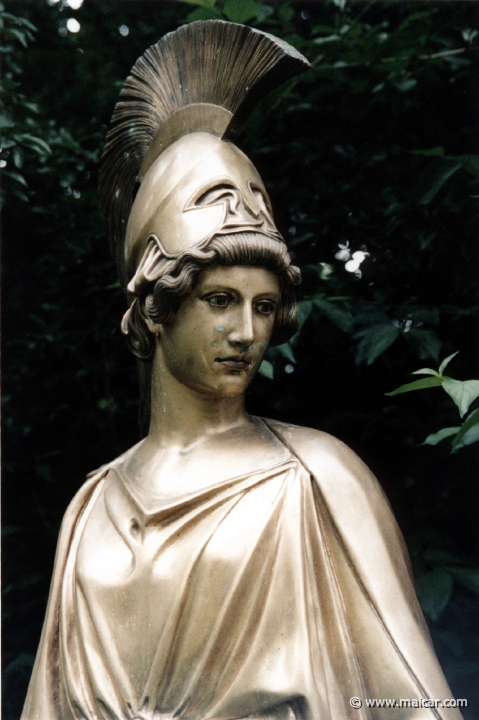
And in mythology there are plenty of images of the female warrior. The very fact that the US involvement in Libya has given rise to talk of "Valkyries of war" is testament to the fear instilled by such images. The destroyer is in many goddess archetypes, like Kali, Nike, Athena (depicted right), Minerva, and indeed the Nordic Valkyries, though interestingly enough
these goddesses also often embody the corollary nature of life-giver,
fertility, mother.And let's not and let's not forget such pop culture warriors as Xena Warrior Princess, Wonder Woman (see my blog post on WW), Shera, Buffy the Vampire Slayer, Lara Croft (or any other number of Angelina Jolie characters!).
We women have the capacity for destruction in us as well. Any notion that women running the world would ensure a war-free existence is naive, unbalanced, destructive to forwarding a new dialogue of equality, and even patronising. Not that I champion women as war-wagers, but let's move on from such essentialist ideas as the "fairer sex" being all peace-loving, and men being the only guilty ones. Let's start from reality and move forward from there.
The other side of this story is that the media jumped onto the idea of the Valkyries, as if the these advisors pushing for warfare were blood-lusting destructive sirens, who lured the innocent Obama into war. But perhaps there were other factors in the political stance taken by these women?
Hillary Clinton was reportedly luke-warm on going in to Libya, but it is asserted that memories of Rwanda during her husband's presidency led her to shift to a more pro-active stance. Sarah Power was given her post in the Obama administration at least partly due to her outspoken stance on genocide and the need to intervene. She has won prizes for her publications on this very point. And Rice was also part of the Clinton administration when the horrors of Rwanda and the failure of the international community to intervene became apparent.
While the atrocities in Libya cannot amount to genocide as a matter of international law, it could be posited that these women were pushing for intervention for humanitarian reasons, rather than for blood-lusty power-based ones.
The point, to me, is that if there is anything "inherent" about war and conflict, it is perhaps the "unconscious masculine" in us all, both women and men. The waging of war for one's own selfish ends - oil reserves to keep the car industry going, control over other resource fuels or water, control over regions which threaten one's own cultural and political domination, religious ferver - these are the result of the unconscious masculine, the shadow of the warrior archetype. And that potential is in all of us.
On the other hand, the conscious masculine, the healthy warrior archetype, is willing to fight when it is necessary. When one's territory, family, safety, integrity is threatened by the force of another's shadow-driven attack. It is entirely appropriate to bring out the (she-)wolf and to fight to the death in some situations. Humanitarian intervention may be what inspires this conscious use of force. In fact it may well be a feminine (note: not "female", but "feminine"!) urge to protect and heal that leads to such interventionist use of force. And that potential is in us all as well. (See my blog post on "Dear Woman")
Valkyries of war? Maybe, but let's consider what is behind the political decision, rather than simply focus on the gender of those pushing for these decisions.
Subscribe to:
Posts (Atom)


