Tuesday, 12 April 2011

Valkyries of War


Though I would not be proud to stand up and say that women are equally responsible for atrocities committed in times of conflict as men, it would be a false dichotomy to deny it. In fact, I find the tendency to point the finger at men for being the wagers of war, and to assert that if more women were in power we'd have less war, to be utterly abhorrent.

Why? Because it creates a divide, and perpetuates another war that is otherwise slowly dying out and really has had its time. The battle of the sexes is no longer a war we need to fight. To lay the blame at the feet of one gender and expect that women, purely by reason of their gender, would not resort to war in international relations, is a naive and divisive standpoint.

This idea has been challenged recently with some interesting twists in the media. Obama was at first reticent to use force in Libya, and many of his (male) security advisors were against getting involved in another expensive, uncertain conflict on foreign shores, given the messes in Afghanistan and Iraq. In the end it appears it was due to the pursuasiveness of three top women advisors in his administration that he was convinced to take military action. And because it was three women, the media leapt on it.

They have been called the "Valkyries of War", and the mission has been dubbed by one journalist as the "war of the three sisters". Juicy stuff! And cause for many questions.

Secretary of State Hillary Clinton, together with Samantha Power, senior policy advisor on the National Security Council, and US ambassador to the UN Susan Rice, are "credited" with having made the final push on the no-fly zone and the US involvement in the UN authorised use of force in Libya. And of course the media love this unlikely trio of war-hungry women, with New York Times stories of the "girls taking on the guys" in the White House, and NBC stories covering the phenomenon of women policy advisors taking on the men.

There seems to be a suprise that women would give the push for involvement in warfare. But there are two sides to this story to consider.

One is that women have, unfortunately, but realistically, been involved in warfare throughout history.
Although it requires a bit of digging to find them, there are many historical examples of women leaders who waged war and fought on the frontlines of battles. Characters like Joan of Arc, ancient Arabian women warriors Kahula and Wafeira, 11th Century Queen of Arragon, 16th Century Grainne O'Malley the Irish Pirate Queen (depicted right, at her historical meeting with Queen Elizabeth I, another determined female leader of the time) are not unique examples. And let us not forget the 20th century's Margaret Thatcher, a prime minister whose legacy includes the Falklands war as well as her integral role in ensuring her pal August Pinochet did not get extradited from the UK for his pending trial in Spain for crimes against humanity.

In recent history there were a number of women on trial at Nuremberg in the Doctor's Trial and the Justices Trial, many of whom were executed for their participation in heinous atrocities at the concentration camps and in the Nazi administration. Currently at the Extraordinary Criminal Chambers of Cambodia, where members of the Pol Pot regime of the 1970's are on trial, a number of women stand as defendants. (See one of my favourite blogs for more info on this: IntLawGrrls, where the image below of Maria Mandel, executed for her role as a prison guard at Auschwitz, is also from.)

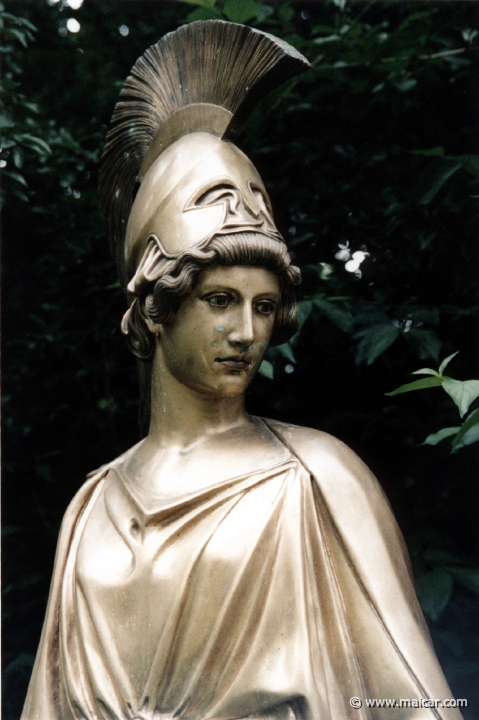

And in mythology there are plenty of images of the female warrior. The very fact that the US involvement in Libya has given rise to talk of "Valkyries of war" is testament to the fear instilled by such images. The destroyer is in many goddess archetypes, like Kali, Nike, Athena (depicted right), Minerva, and indeed the Nordic Valkyries, though interestingly enough these goddesses also often embody the corollary nature of life-giver, fertility, mother.
And let's not and let's not forget such pop culture warriors as Xena Warrior Princess, Wonder Woman (see my blog post on WW), Shera, Buffy the Vampire Slayer, Lara Croft (or any other number of Angelina Jolie characters!).


We women have the capacity for destruction in us as well. Any notion that women running the world would ensure a war-free existence is naive, unbalanced, destructive to forwarding a new dialogue of equality, and even patronising. Not that I champion women as war-wagers, but let's move on from such essentialist ideas as the "fairer sex" being all peace-loving, and men being the only guilty ones. Let's start from reality and move forward from there.

The other side of this story is that the media jumped onto the idea of the Valkyries, as if the these advisors pushing for warfare were blood-lusting destructive sirens, who lured the innocent Obama into war. But perhaps there were other factors in the political stance taken by these women?

Hillary Clinton was reportedly luke-warm on going in to Libya, but it is asserted that memories of Rwanda during her husband's presidency led her to shift to a more pro-active stance. Sarah Power was given her post in the Obama administration at least partly due to her outspoken stance on genocide and the need to intervene. She has won prizes for her publications on this very point. And Rice was also part of the Clinton administration when the horrors of Rwanda and the failure of the international community to intervene became apparent.

While the atrocities in Libya cannot amount to genocide as a matter of international law, it could be posited that these women were pushing for intervention for humanitarian reasons, rather than for blood-lusty power-based ones.

The point, to me, is that if there is anything "inherent" about war and conflict, it is perhaps the "unconscious masculine" in us all, both women and men. The waging of war for one's own selfish ends - oil reserves to keep the car industry going, control over other resource fuels or water, control over regions which threaten one's own cultural and political domination, religious ferver - these are the result of the unconscious masculine, the shadow of the warrior archetype. And that potential is in all of us.

On the other hand, the conscious masculine, the healthy warrior archetype, is willing to fight when it is necessary. When one's territory, family, safety, integrity is threatened by the force of another's shadow-driven attack. It is entirely appropriate to bring out the (she-)wolf and to fight to the death in some situations. Humanitarian intervention may be what inspires this conscious use of force. In fact it may well be a feminine (note: not "female", but "feminine"!) urge to protect and heal that leads to such interventionist use of force. And that potential is in us all as well. (See my blog post on "Dear Woman")

Valkyries of war? Maybe, but let's consider what is behind the political decision, rather than simply focus on the gender of those pushing for these decisions.

Friday, 8 April 2011

The next wave?

I was in Montreal recently with my man, who is Quebecois. He had told me that in Quebec there is quite a militant feminism, and he often feels blamed by angry women when he enters any conversation about equality between women and men. He just ends up getting frustrated, there is no dialogue.

He said there also seems to be a double standard. On the one hand these women are angry at men for stamping them down and oppressing them, and they want to be leaders in their own right. They want men to be sensitive and caring. On the other hand these women don't respect a man who is weak, they complain that men in power are failing at being leaders, and they still want to be taken care of emotionally by the men around them.

This has left my man and his male friends perplexed and dismissing "feminism" as "man-hating". They feel utterly excluded from the entire discourse because the discourse is focused on blaming them, blaming men.

I found this all pretty fascinating. There are clearly cultural moves to feminism which show up differently at different times in different countries. What my man described to me as we drove towards his home town Montreal sounded to me like the echoes of second wave feminism. As I said to him, there was a time when this anger, this militance, was necessary. Maybe it always will have some kind of place, but second wave feminism, dubbed "women's liberation" in the 1970's and 80's, needed to be angry. It was the time of the sterotypical image of burning bra's, refusing to change one's last name if one was married, adopting "Ms" as a title, and being loud and proud about being lesbian, screaming out about oppression of women whether it be sexual, in the workplace, or at home.

Looking back at the "first wave" of feminism, known as womens' suffrage, in many developed western countries this movement in the early 20th century had given women the vote, property rights, and more access to the workplace. During the second world war, women in fact dominated the workplace and learned new skills in the labour market. Most of the men were off fighting in the war, women were needed in the workforce to keep the economy going. The quintessential image familiar to so many of us hailed from the U.S. War Production Co-Ordinating Committee, encouraging women to work to help the war effort.


And then, after the end of the second world war, what are the quintessential images of women in the western world? Happy homemaker, devoted housewife, desiring only to please her husband, raise good children, and over the moon when she is presented with modern whitegoods to make er job even more of a pleasure...this was a polemic shift to undo what the second world war had done to women's participation in the economy. Put women back in the home to ensure that men can return to work. Womens' economic participation became hidden and undervalued.

Of course women were angry. Having made so much headway, women were being told they should not proceed in careers, they should not work in skilled or unskilled labour, they would be paid less than their male counterparts for the same work, they should stop working when they got married (up until the 1960's in many western countries women lost their property rights and economic autonomy once they got married and became legal children, dependent on their husbands to sign all contracts and make all purchases) and at the same time sexual images of women were increasing in advertising, film and tv, decreasing women's value as anything other than a sexual object.

Of course women were pissed off! They needed to make noise to make the next wave, the next shift. And thus began the "second wave" of feminism.

And of course men were affected by this. And of course many women felt threatened by it too. (Women have often been the harshest of critics against their sisters who make noise abut women's rights) So in the 1980's we got the whole phenomenon of the backlash, depicting feminism as man-hating, and all feminists as butch dykes with no sense of femininity. "Power dressing" women were reaching higher positions professionally but were being ostracised by both their male and their female counterparts.

This backlash is what I heard in the background of my man's frustration towards the militant feminism he described in his home town. It is also something I recognise in the reaction many people have to the word "feminism" in the Netherlands, where I have lived for 12 years. There, people look with suprise and say "but women's emancipation is a fact, we're finished, it's done! What are you complaining about?" Feminism is a dirty word because it is associated with the push of the second wave, and since we are done addressing those concerns, it should be put to bed and forgotten about.

Perhaps I am simplifying things too much by saying it is cultural, but what strikes me is that the third wave of feminism that dominated Anglo-American academic discourse in the 1990's and early 2000's doesn't seem to have made it's way into some western countries' culture.

The third wave was all about being inclusive. Feminst scholars started to realise they were writing and speaking about the experience and perspective of the white, middle class, western woman. A black woman in the US may however identify more closely with black men who experience society in a certain way due to their colour, race or ethnicity, than she does with a white woman who shares her gender but nothing else. An Indian-born Hindi woman living in London might identify more closely with a Hindi man in than with an English-born Christian woman. A woman living in poverty in a developing country, or an indegenous woman in Australia may experience the world through her place in the economy more than through her gender identity. In order to rectify the fact that feminst scholarship was in fact guilty of the same hegemonic tunnel vision which it criticised in paternalistic or masculine-dominated world views, it started to deconstruct itself (part of the post-modernist buzz at the time) and aim to be more inclusive of diverse voices and experiences.

Ultimately, third wave feminism has many voices, there is no "one" feminism. A difference theory feminist will disagree on some substantive issues with an equality theory feminst, or a critical race theory feminist. In the end, post-modernism taught feminism that it is about the oppressive structures in society much more than it is about "men" oppressing "women". Gender is not at the cause, it is at the effect. And it may be only one (however important) effect. The same oppressive structures and belief systems oppress minorities of race, religion, ethnicity, create poverty divides and affect our environment. This inclusivity of different voices led to recognition of different experiences under these constructs and the need to consider different solutions. Inevitably, it led to recognising the need to include men's voices and experiences as well.

Therefore to make any real change, we need to include EVERYONE in how this change is to come about, and how we can all re-imagine our roles in socoiety. To me, this is the next wave, the fourth wave perhaps? The shifts that feminism has brought about has impacted both men and women. Giving women the space to participate in the economy and in policy making and in academia has meant men have had to reconsider their position in society as well. In fact if what we are seeking is equality, then there needs to be an equality in the discourse too.

What we are all seeking now is a re-balancing. We have torn down a language of oppression, we now need to shift away from any language of blame, and towards a language of responsibility. We need to take the focus from gender and place it on masculinity and femininity. A re-invention and rediscovery of what these things are can lead to a re-balancing in society, where men and women feel included in moving things forward.

Many would say the "battle of the sexes" is over, but some people are still fighting it. I would say it's more important to seek a balance between masculine and feminine within oneself, in order to understand the strengths and weaknesses, the divinity and the shadow, of each of these aspects of humanity. Once we can do that within ourselves, find that balance between masculinity and femininity, then we have something more worthwhile to contribute to the project of equality in the world.

It's a pity, in that respect, that I had to concede there was something in what my man had described about his experience of the blame-game in his home town when he pointed out a poster to me. It was advertising a network group for men - a support group, a group to just get together and talk about being men. I thought it was a fabulous idea, to be celebrated! But someone had stuck a sticker over it saying it was sexist advertising.

Sexist? Only if you think men getting together to talk about their masculinity is sexist. I would say quite the contrary - it's sexy! So damn sexy because it's a move toward the very re-balancing we all are seeking.

Dear Woman

A friend of mine sent me this video. He said he was so moved by it, but he also said opinion seems to divide in people's reactions based on whether they really get it, or really don't. It's called "Dear Woman..."

I invite you to take a few minutes to watch it. When I did it had me sobbing.

Not because I felt it was necessarily addressed to me, but because it is addressed to the feminine and to the suffering caused to the feminine by the unconscious masculine. And I found myself tuning into that suffering and feeling it - really feeling it rather than reading or hearing about it.

What struck me most is the authenticity with which each and every man in that video speaks. I am drawn to their hearts, all of them. I am inspired by their courage and honesty. I feel like entering a meaningful dialogue with each of them, preferably beginning by just looking into their eyes.

Part way through I did feel there was a collapsing of "sex" and "gender". It's easy to say men have waged wars and women have suffered, and that women don't wage wars. It may be historically true that women have not often waged the wars that are fought, but it is also historically true that not many women have been in positions of power, at least in the last millenium or two in most societies. When women are in positions of power, we have the same capacity to wage war and we have participated in wars as perpetrators as well as victims. (see my other blog post on the Valkyries of War)

It is also an easy leap to make that women have only been victims of the unconsious masculine as expressed through men's actions. But this reduces it back to a battle of the sexes, a blame culture. Collapsing "masculine" with the gender "male" and "feminine" with the gender "female" can lead to a false perpetrator/victim dichotomy and a demonisation or idealisation of what these aspects of humanity are.

But as I kept listening I realised this collapsing redeemed itself. The men spoke also of the suffering endured by
men at the hands of mothers, sisters, partners, ex-partners. They also speak of the balancing of masculine and feminine within each of us. Coming together and worshipping the divine in both these energies through our bodies sexually, and through our approach to world economy, global justice, social equality, is what can create miracles, just as these men proclaim.

What really touched me, what I appreciated, was the words spoken in responsibility, apology, forgiveness and the will to move forward. This to me is the only way to affect change. This is the next wave (see my blog post on this).

But what is required is for both genders, men and women, to embrace both the masculine and feminine within? The harms these men refer to are not a matter of men perpetrating on women, but rather of the (unconscious) masculine in all of us perpetrating on the feminine in all of us. True, women as a gender have suffered physically and politically on a more outrageous scale and more often. But it does not end there. Women have colluded as well, men have suffered as well. We need first to find a balance within. From there we can create a balance in the world.

So my response to this inspired video would be:
"Dear Man,

I thank you for your will to reach out and communicate. I acknowledge the courage it takes to face what the unconscious masculine has affected on humanity, and to own it as a part of who you are. I honour the strength it took you to really see this, to feel its impact, and to move beyond shame to a place of responsibility.

I feel blessed by the way you worship the divine feminine in me. It invites me to move into it more deeply, to trust my own intuition, to develop my capacity to feel and express joy, sorrow, forgiveness, love. It invites me to open up to you more and explore what is possible between us.

I am grateful for how you acknowledge the horrors of the past. It allows me to feel the sorrow, pain and suffering as well, which is one of the roles of the feminine. To have these things expressed and acknowledged, rather than denying them, is to help them heal.

I also take responsibility for what the unconscious feminine has done to affect humanity. The quashing of divine masculinity, the shaming of boys and men, the judgmental restriction of women's sexuality, the fighting of dirty fights. These are a function of the unconscious feminine, and I take a stand for the healing of these things as much as for the suffering caused by the unconscious masculine.

The words you speak of embracing the masculine and feminine within all of us inspire me to own my own part in the unconscious masculine as a part of me. And these words inspire me to come into a profound relationship with the divine masculine in me, and to develop and worship the divine feminine in me.

For in embracing and worshipping the masculine and the feminine, in moving towards healing, moving towards equilibrium, there must be a balance sought within. Your words to me inspire me to have this conversation with myself as much as I will have this conversation with you. Those miracles you speak of will occur when we see we are both a part of each other.

Bless you for being in this dialogue with me. And welcome."

Wednesday, 27 October 2010

Sex Positive

WHat does one do on a Sunday night in Amsterdam? Why, attend feminist porn star Madison Young's "Sultry Soiree" of course, hosted by King Betty, a transgender/queer organisation whose tagline is "any gender is a drag".

Madison Young is perhaps best known for her bondage porn, much of which is considered mainstream. But she has also taken a platform within the porn industry to promote the sex positive movement, and to assert a feminist celebration of what it is to be submissive. Her website tells the story of a kinky girl next door who insists she is changing the world one orgasm at a time. She features in and makes films in which "you will find women and men having real orgasms and something that is a rarity in porn – connection. For me art and porn are closely intertwined and I like to see the two come together here on my web site and in my art work."


Given that various feminist ideologies started to split in the 1980's over such questions as whether all porn is offensive to women, all sex is rape, and the normative disagreements between "difference" versus "equality" politics, to assert one is a "feminist porn star" is to move beyond third wave post-modern feminism and into a new wave. A young goddess friend pulled a confused look when I told her Madison promotes female friendly porn. "But I am into porn anyway! What's not friendly about it?" I realised she was never exposed to the debate on porn and the commodification of women, and she is part of a generation in which pole dancing has become a sport and the use of sex to sell everything from cars to mobile phones has truly become the norm. There is something to this young goddess' dismissiveness of the "porn is exploitation" stance, but it requires women like Madison to keep pushing the boundaries and ensuring that there is some authenticity to what's being displayed about women's bodies and sex.

So what is Madison's stance all about? The Soiree began with an afternoon discussion in which Madison explained that porn for her is both educational and political. Rather than directors telling the performers what to do and how to do it, she starts from what fantasies the performers have and creates authentic erotic scenes from there. It's about what the women (in particular) want, rather than producing what the director thinks the male viewer wants. It is a celebration rather than a commodification of sex.

The evening session of the Soiree featured the world premier of Madison's new film "Femmetastic", in which femme lesbians - in the 1990's referred to as lipstick lesbians - created the scenes from their fantasies. The most intimate and erotic scene was of one woman alone in a laundromat who cheekily, sneakily sits on top of a washing machine and, looking to see if someone will come in, starts to play with herself as she is rocked and hummed by the vibrations of the machine. The orgasm she brings herself to is humble but beautiful. And the slightly see-through white singlet and skinny jeans she wears teases mean and women, gay, straight, bi-, trannie, alike.

After a short discussion on her film, during which I asked her whether sex is always political for her (to which she answered "yes, every time I f**k it's political!") we were treated to some impressive bondage performances involving women being tied with complex Japanese-style ropes and hung from the beams of the Amsterdam home we were in. The women who were tied enjoyed the attention but most of all the surrender and the trust of giving over to their master artists.

Finally Madision gave us a performance dedicated to Annie Sprinkle (prostitute and porn star turned sex educator and artist) and her wife Beth Stevens, who were celebrating their wedding anniversary with a 7-year performance series. Madison washed her naked body with grapes and grapejuice and offered purple bubble gum to audience members which she then stuck to her body, all the while exuding eroticism and creativity. The most subversive element to her perfomance, however, was the fact that she is 5 months pregnant, her swollen, fertile belly a part of her seductive movement and tantalising ease with being naked and spread open to viewers.

Sex positive? You bet. The fluidity of gender identity, gay and bi-sexuality, the beauty of the female form, the talk of poly-amory, the images of various women's sex toys and the notion that porn has moved beyond the need to be "female freindly" and is now "femmetastic".... The evening was aimed at women with some men invited to join, but the point was that anything goes when gender and sexuality boundaries are on the discussion table. It was the first time I've sat through a porn film in a room of about 50 people whose attention was as much on the art and political comment as on the hot orgasms we were viewing.

Changing the world one orgasm at a time...that's a pretty sex positive mission statement!

Monday, 4 October 2010

Hair!

I recently saw a fabulous comedy piece at the Amsterdam Fringe Festival called "The Freak and the Showgirl". Mat Fraser was a thalydamide baby and has deformed arms and hands, and Julie Atlaz Muz is a sexy burlesque dancer and together they have created one of the funniest, most politcally subversive pieces of comedy/burlesque you are bound to see in this lifetime.


Mat has spent a lot of time researching how handicapped people are depicted in pop culture, on tv, in film, in theatre. He has a lot to say on the matter from personal experience, and he also has some great pistaches from 20th century freak shows at the circus. Our endless fascination with what is "abnormal" makes the audience uncomfortable at first, but Mat's whole stage persona has everyone on his side within minutes and laughing at his whole "porn for handicapped people" satire.

Mat couples with the lovely Julie Atlas Muz, whose burlesque dances are subversive as hell - Little Red Riding Hood wearing a wolf mask, a prisoner chic who strips off completely naked, lights a ciagrette, tears up a €5 note, mimes fellatio and sodomy and then ends her piece with a political speech about how all these things are illegal in a lot of places and we need to stand up for our freedoms. Together they have a lot to say about how we objectify bodies either as freakish or as sex objects.

In the space of a bit more than an hour they are in various stages of undress, have audience members in hysterics and covered in beer, and have given much food for thought in a most entertaining way.


The thing that stuck with me most of all was almost incidental in terms of the "messages" they had. But it was anything but incidental in the show. When Julie was completely naked (breaking one of the ground rules of burlesque) it was apparent to the entire audience that she does not adhere to the social convention of shaving or waxing her pubic hair. She pointed this out and gave us all a good look at the full bush she sports. And she also pointed out that the fashion to shave or wax is a way of succumbing to the male fantasy of a young girl's hairless vagina. If we are to be women celebrating our sexuality fully, she contends, we should be letting it all grow.


And to prove her point, she introduced us to Mr Pussy, and we were treated to a film projection the size of the theatre wall of her vagina wearing sunglasses and with the hair braided into a moustache and beard, as she took "lip synching" to a new level. Her vagina lips sang to the theme song of the musical "Hair" and the visuals were tear-rolling hilarious as she went spotted, polka dotted, spangled, jangled, braided and confettied....long hair like Jesus wore it, Hallelujah I adore it!


I used not to shave anything - armpits, legs, pubic hair. It was a political statement as much as a fashion statement at the time. But I too eventually succumed to the pressures of what society and a few men told me was more sexually appealing. I watched this piece in full appreciation and pondered whether the choice to de-hair has truly been my own. I wonder if Julie Ataz Muse can bring "freak" and "showgirl" back into one shared vocabulary across the globe? I wish both her and Mat well on their mission in any case!

http://www.matfraser.co.uk/
http://www.julieatlasmuz.com/


Wednesday, 25 August 2010

Does having children make you happy?

After a discussion with my goddess-in-training sparring partner and housemate about the dream of being parents and the impact children would have on our lifestyles, she sent me a Newsweek article which declares it is a fallacy that having children will make us happier. It's not the first time I've come across this scientific conclusion - many studies have shown that parents tend to measure their happiness and life satisfaction lower than non-parents. But I do wonder about the premise of these studies.

I found an interesting take on it in this article on The Psychologist webpage, which asserts that it has more to do with our focus than our actual level of happiness. Parents tend to spend lots of time worrying about their children and this is what shows up when studies are done. When we think about a rosey future - be it a life-long relationship, being a parent, living in the Bahamas, getting the particular job we really want - we tend to focus on the positive aspects of that future possibility. Of course we don't focus on what's going to be difficult about it or how much work it's going to take. And when reality hits, we focus on the difficult things more than the positive.

It's like when I think about my current work. I have a dream job where I am surrounded by relaxed, supportive, friendly colleagues, with very little power struggle or hierarchical frustrations, where I am paid a decent salary to learn every day, do research and teach. Yet there are plenty of aspects of my work I find a challenge, or frustrating. Right now as I write this blog I am avoiding the preparation that the next subject I am to teach requires, because it is less inspiring than thinking about being a mother and everything that entails! But does that mean I am unhappy at my work? By no means! I can focus on the positive or the negative aspects and the net result will change depending on that. Meanwhile it is a part of a longer career path and overall I am very fulfilled, partly due to the very challenges and opportunitites to learn and grow.

Just as I imagine being a mother will have its ups and downs, and periods of a lot of hard work, yet it is part of something bigger. The biological and emotional call to be a mother has little to do with instant gratification or daily bliss and more to do with fulfilling something human, a call to another phase of adulthood, to a contribution to life and the world around me.

And that is not to say we should all sense and follow a biological or emotional call to be parents. Not everyone wants children. Also, I often have these kinds of conversations with women around me who feel that being a mother will mean sacrificing the full extent of their career. This of course depends on many factors including social infrastructure and flexibility in the workplace, as well as culture (see my post on why there are so few women in higher academic positions). But if it'a question of "what will make me happier - my career or being a mother?" I say the assumption is all wrong that we should be doing things based on a drive for some kind of intangible measure of happiness.

Surely being a parent is not about weighing up the hard work against the moments of reward. I would say the questions being asked in such studies are a bit skewed. Of course no-one enjoys the tasks associated with childcare. But can that be measured against the moments of insight into innocence? Or into how humans grow and develop from crawling, drooling dependent creatures to creative, independent, thinking beings? Or the moments of seeing life continue through you? Or the moments of pride, joy, self reflection, fulfilment? Or the moments as grandparents where it call gets repeated again?

Without the experience (yet) of being a parent perhaps I speak with a bit of a utopian perspective, but at least it's not one based on the disillusion that I will by definition be "happier" as a mother than if I don't have children. It's one inspired by a dream I had of sitting on the grass with my pregnant belly, watching my other young child play in the garden, my man sitting behind me with his legs either side of me and his big chest behind my back. Something essentially human and undeniably fulfilling was coarsing through me. That dream may or may not come true, but it is something that calls me just as much as my career aspirations do and my creative outlets do and the yearning I have to share my life with a partner who is my equal. Will I be happy or happier? I don't know. Will I be fulfilled at a deeper level? I believe so.

(PS - I'd be curious to see comments from anyone who is a parent!)

Saturday, 31 July 2010

The New Wonder Woman?


I've posted in the past about Why I Love Wonder Woman and everything she stands for. Her back-story is one of female strength, wisdom and beauty, bestowed by the gods and representing everything that a female warrior is. Her creation is one of early feminism, and she stands for peace and justice. So it's probably about time they made a film about her, among the spate of comic book heroes being brought to life on the big screen.

It's a shame, then, that DC Comics have decided it's time to "update" this 70 year old icon. Modernisation is not a bad thing in and of itself, but if it entails changing everything familiar about this female role model, from her costume to the very roots of her existence, one has to question it. Why, oh why DC???

Their justification for changing her famous costume has been that critics questioned how WW could fight crime without her bits falling out. She's a comic book super hero, people! They always fight crime without their bits falling out! That's why Superman wears his underpants on the outside and Catwoman never has to zip herself in or out of her impossible latex getup.

It should be said, WW has been "updated" in the past. Originally her creator had her wearing a star-spangled skirt, until it was conceded this would be flying up and around her head most of the time she was in action, so they put her in shorts instead. These gradually became hotpants and then even a high-cut leotard over the decades, but at least they remained recogniseable as WW's getup.


Reducing WW's bust size may be a bit of a more realistic move, but removing the gold W from her breast??? Granted, this was only introduced in the 1980's, prior to which WW wore a golden eagle on her chest. She had, after all, been invented during the second world war as an American hero. DC decided to make er appeal more universal by having the Wonder Woman Foundation (an actual women's rights organisation) present her with a doubled W and asking her two wear it to represent women around the world.

So she has seen some changes over the years. The worst was in the 1960's when the story writers for some inexplicable reason decided to remove all her powers and her costume altogether, and name her The New Wonder Woman. She was a mod crime fighter in a fashionable 1960's minidress, but she was not a super hero. Thankfully DC returned to its senses in the 1970's and WW was given back her true identity.

Given that WW's readership has always been slightly smaller than that of her male counterparts, and given the trend of bringing our old fave comic book heros to the big screen, now is indeed the time to vamp up WW's image. There has been talk of a film for many years now, but beyond the basic 80's style animation film that was released straight to dvd in 2009, not much movement has been made. So it is understandable that at a moment of celebrating her 600th (unofficial) issue on paper, DC is looking to gain more attention for its protagonist female, and one suspects the push to film may follow.

But it was a mistake to mess with her backstory, depriving her of the upbringing on Paradise Island (Themniscyra) among the Amazon women, shifting her pacifist origins into an urban commando chic. And it was a big mistake to strip her of the familiar colours and garb we have come to know. Especailly as it has been reduced to bad 1990's bolero fashion and black skin-tight trousers. She has lost all originality.

She resembles the splinter character Donna Troy (right), who was developed from WW's adopted younger sister.


Her bullet-resisting bracelets have become tie-on gauntlets and her corset has an eerily Spiderman-like design. And perhaps the black choker was introduced because the new gauntlets have lost their subtle suggestion of S & M (which WW's original creator had as part of her sexuality and her strength). Unfortunately the overal result is a shopping mall teenager instead of a mature arse-kicking ambassador of justice.

DC, if you want to raise the profile of this all-important female hero, do so with some respect for her creation, her symbolism and her long-lasting appeal. If you reduce her to a fashion victim with a less impressive history driving her, the endless stalling of bringing her to film will continue. Everyone wants to put her on the big screen, no-one knows how because of the inconsistencies in her character. Keep it simple, keep it strong. And keep true to what is so insipiring about this feminist, pacifist heroine.